

Changes in the vehicle parc are reshaping aftermarket catalogues, even within well-established product families. The intercooler is a good example. Alongside traditional air-cooled units, liquid-cooled intercoolers are becoming increasingly common. This is a more recent solution, used mainly on the latest generation of turbocharged engines, and it works on a different principle.
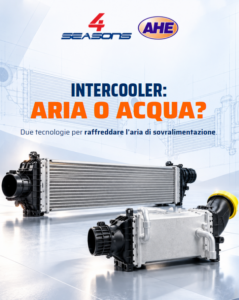
Two solutions, same job
In turbocharged engines, compressing the intake air raises its temperature significantly. The intercooler cools this charge air before it enters the engine. Both technologies do this. What differs is how the heat is dissipated.
Air-cooled intercooler
The heat passes directly to the outside air flowing through the exchanger fins. To make the most of the ram air created as the vehicle moves, the air-cooled intercooler is normally fitted at the front of the vehicle, usually in front of or next to the engine radiator.
Water-cooled intercooler
The heat is transferred to a coolant circuit. The exchanger does not need to be exposed to the airflow, so it can be more compact and does not have to sit at the front of the vehicle. The path of the compressed air is shorter, which improves turbo response and cooling efficiency.
Implications for the aftermarket
For parts distributors and workshops, the spread of these two designs has a practical consequence: the name “intercooler” is no longer enough to identify the right part. You need to check which solution is fitted on the specific application, using the OE number and the vehicle data. On air-to-liquid systems, it is also advisable to check the condition of the dedicated cooling circuit when replacing the unit.